Where the next homes go
We're going to build homes here. Where they go is the part still up for grabs, and hardly anyone is talking about it.
490 homes
What Fairfax has to plan for between 2023 and 2031. 31 are built. Zero at the very low income level. ADUs are running at 5 a year against a target of 20.
- 31 built
- 459 still to permit by January 31, 2031
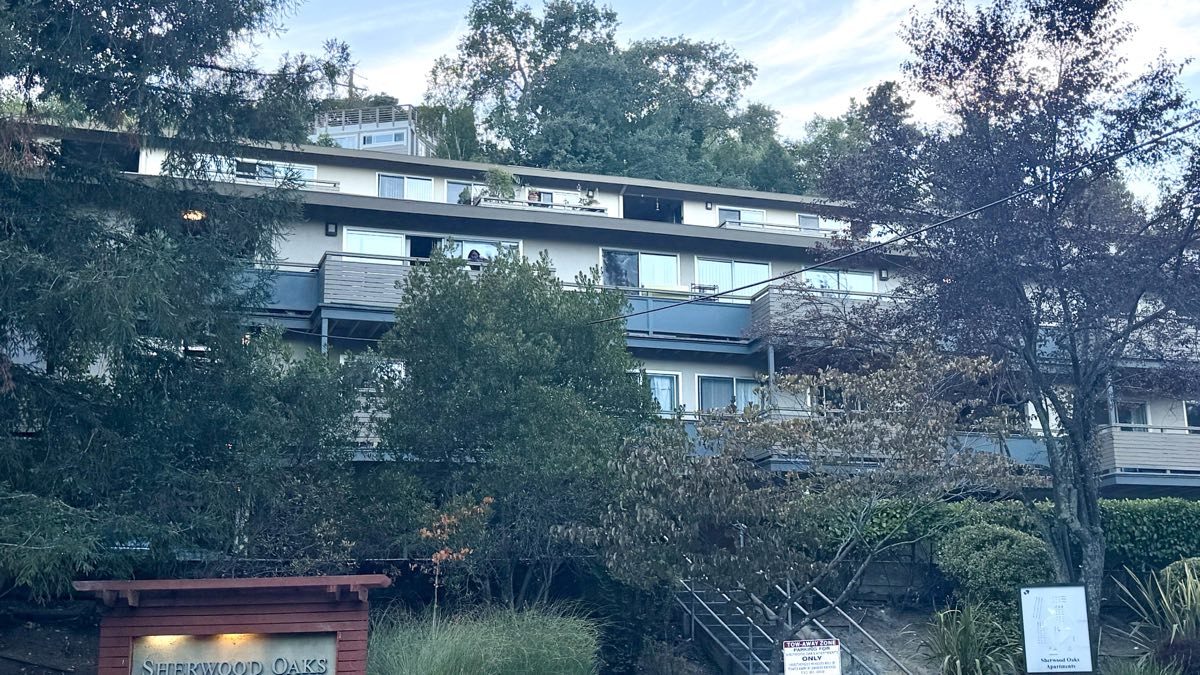
Same height. Nobody notices it
Sherwood Oaks has been on Bolinas Road for decades, roughly as tall as the building people are angry about.
Sherwood Oaks is roughly the height of the building people are angry about. It's been there for decades and nobody thinks about it. The difference isn't scale. It's that a hillside hides a building and a flat downtown site can't.
That's a real design point, and it was never argued, because nobody was allowed to argue anything.
Where things actually stand
School Street Plaza, 243 units at 95 Broadway, received its full entitlements on May 14, 2026. It's final. It isn't coming back to the council, and no candidate elected this November can undo it.
Anyone telling you otherwise is selling you something. Better you hear it in August than discover it in January.
I also want to be honest about how little of this a town council still controls. Accessory dwelling units. Junior ADUs. SB 9 lot splits. The state density bonus. Any project with 20 percent or more affordable units under the Town's own Workforce Housing Overlay. Every one of those sits outside council discretion, either as state law or as a ministerial track Fairfax already adopted for itself. The council doesn't get a vote. A candidate campaigning on personally approving or denying these is describing a job that no longer exists.
About 460 of the 490 units are still unplaced. The cycle ends January 31, 2031. And a unit counts toward the Town's obligation on the day a building permit's issued, not the day someone moves in.
Which means the decision that actually matters over the next four years is where those permits get steered.
Right now the default answer is downtown infill, because downtown parcels are the ones with an active pipeline. I don't think that's the right answer. Downtown is the thing people move here for, its streets are already the constrained ones in an evacuation, and concentrating the remaining allocation into roughly six blocks is a choice rather than a requirement. It's simply the choice that gets made by default if nobody makes a different one on purpose.
The alternative is to look hard at the town's large, flat, already serviced parcels, and to do that work now, deliberately, through a proper sites inventory reassessment. Not reactively in 2029 with the clock running down.
It's harder than it sounds, and this is the part that cuts against me. Fairfax's flat land is its floodplain land. Substantial parts of the parcels people point to sit inside the 100 year flood plain, which is precisely what the flood work is about. And the last time Fairfax voters were asked directly to rezone the town's biggest flat site for housing, in June 1998, they refused, 2,401 to 681.
That was a different proposal in a different legal era, and state housing law has been rewritten twice since. But it tells you this isn't a free idea.
Rent control, and what it did to the small units
We've already been through this once.
In November 2022 the council adopted rent stabilization by 5 votes to 0, and just cause eviction protections by 4 to 1. Fairfax became the first jurisdiction in Marin, and the smallest in California, to pass rent control. Rent increases were capped at 60 percent of inflation, or 5 percent, whichever was lower.
In November 2024 the town repealed it. Measure I passed by roughly 68 percent to 32.
A council voted for it five to nothing. Two years later the town undid it by better than two to one.
The people who wrote those ordinances were trying to protect renters from real harm, and some of what was in them was good. Nobody set out to make things worse.
But it isn't fair to treat every landlord here as though they were a large corporation. A lot of the rental housing in this town is somebody's converted garage, a unit over a shop, a second cottage on a lot, or a duplex that's somebody's retirement. Those owners pay the same insurance increases and the same repair bills as everybody else.
What I hear constantly, and what I believe happened, is that a good number of those owners took the unit off the market rather than carry the risk. The people that hurt weren't corporations. They were long-time locals and people who work here.
I can't prove that with a number. It hasn't been counted.
The ADU problem, still undiagnosed
- 5 built a year
- 15 short of the Town's own target
Nobody organizes against a cottage behind a house, and permitting isn't the barrier, because these are approved as of right. So the shortfall is something else.
Cost. Financing. Sewer capacity. Contractor availability. Whether people know the rules changed. Or whether owners who lived through 2022 to 2024 decided that renting out a small unit was more trouble than it was worth.
Those have very different fixes, and you can't pick one until somebody asks. As far as I can tell, that question hasn't been put.
- School Street Plaza received full entitlements. 243 units, final
- The housing cycle ends. About 460 units still unplaced
The questions I would ask
On the projects where the council still has a say, and there are fewer of those than most people think, these are the questions I want asked out loud before a vote rather than afterwards in a complaint.
Can the roads take it. Can a fire engine get through. Is there water and sewer capacity. What happens to this street in an evacuation. Where does anybody park. And the one that gets skipped: does this actually produce homes that people who work here can afford.
None of those is a reason to say no. They're the things you need answered before yes or no means very much.
What I would do
- Ask staff for an honest, updated sites inventory with flood, fire and access constraints scored and published.
- Use the Workforce Housing Overlay deliberately, as a steering tool, instead of letting it operate only wherever a developer happens to file.
- On projects already approved, the job is enforcement: haul routes, hours, parking, dust, and whether the conditions of approval are actually being checked by someone with the authority to stop work.
- Report annually, in public, on the three numbers that are real. Units permitted. Units built. Units at the very low income level. That last one is currently zero, and it doesn't get said nearly often enough.
- Watch what kind of housing we get, not only how much. Smaller homes, accessory units, apartments and housing a teacher or a nurse or somebody's parent can afford all count the same on a spreadsheet and count very differently to a person.
Build where it makes sense, protect what we already have, prepare for fire, and don't lose the thing that makes Fairfax worth living in.
What I don't know yet
Which of the town's larger parcels are genuinely buildable once flood, access and utilities are scored honestly. That's what a sites inventory reassessment is for.
Why ADUs are running at a quarter of target. A short survey of the people who own small units here would settle it, and it would cost almost nothing.
Am I missing anything?
If you know something about where the homes go that I do not, or you would go a different way on it, I would like to hear it.
Your name and neighborhood help if you are happy to give them. Nothing you send will ever be shared without your permission, and I would never sell your information.
Last updated . Corrections