Did you know?
What our town actually is
I could not have told you how many homes are in Fairfax before I went looking. Most people can't. Then we spend an entire election arguing about them.
7,605
People, living on 2.23 square miles. That's 3,410 of us per square mile
3,470
Homes in Fairfax. 2,128 owned, 1,156 rented, the rest empty
490 more
What the state requires Fairfax to plan for by 2031. That's 14 percent more homes than exist today. 31 have been built
Fourteen percent more homes, over eight years, on two and a quarter square miles of hills and floodplain. That is the housing argument, all of it. Worth knowing the real number before someone tells you it is either nothing at all or the end of Fairfax.
What I would actually do about any of it is on the six issue pages.
What the ballot has already decided
Why it matters. Campaigns love to refight arguments the town has already settled. Fairfax has been asked five plain questions in six years and given five plain answers. It will tax itself for wildfire protection. It will tax itself for town services. It repealed the rent control its council had adopted unanimously. And it declined twice to remove that council.
We are not a town that doesn't know its own mind. We are a town that will back its council on some things and overrule it flatly on others, which is about what you want. If a campaign only makes sense when one of those five went the other way, it is running somewhere else.
There's a fifth result worth adding to that list. In November 2024 the town voted 62 percent against an $18 million road bond. Fairfax will pay for wildfire protection and for town services, and it declined to pay for the roads.
The roads
0Fairfax is at 53100
Why it matters. The backlog behind that score is about $36 million. The Town spends $15.9 million a year on everything it does. So this is not a problem anyone fixes in a term, whatever they tell you at a candidate night. It is a problem you manage for a decade, and the honest question is who manages it well. See streets.
The homes
- 31 built
- 459 still to permit by January 31, 2031
- 5 built a year
- 15 short of the Town's own target
Why it matters. The state does not make us build these homes. It makes us allow them. That sounds like a small distinction until the cycle ends with the number unmet, and then Fairfax loses the say it has now over where they go. ADUs are the version of this nobody objects to, and we are getting a quarter of what we planned for. I would like to know why. See housing.
Where the money goes
- General Fund
- The Town's main account. It pays for police, fire, the roads crew, the planning counter and the people who run the place.
- Revenues
- What the Town collects itself: property and sales tax, the local taxes voters have passed, business licenses, building permits and fees.
- Transfers in
- Money moved across from the Town's other accounts, which are separate pots set aside for particular jobs. It is legal and common, and it only works while those other pots have something in them.
- Appropriations
- Permission to spend. The council votes a number for each department at the start of the year, and that is the ceiling.
Why it matters. The General Fund spends about $4.94 million a year more than it takes in, and covers most of the difference by moving money over from other funds. That is legal, it is normal, and it works right up until the other funds are empty. It is also why the balance fell from $5.29 million to a projected $1.67 million. There is $410,550 the transfers don't cover, and I have asked in writing where that comes from.
61.2%goes to police and fire
- Police $5,475,235
- Fire $4,281,478
- Everything else $6,161,087
Everything else the Town does. $6,161,087. Roads, parks, planning, the Pavilion, staff, insurance and every project anyone asks for, out of what is left.
- Why this matters
- When people ask why the Town cannot afford something, the honest answer is usually that most of the money was spoken for before the question came up. That is normal for a small California town. It is not a scandal, and it is not an argument against either service.
Why it matters. Six of every ten General Fund dollars go to police and fire. That is normal for a town this size and it is not a complaint about either one. It does mean that when someone asks why the Town cannot pay for something, the real answer is usually that 61.2 percent of the money was spoken for before anyone sat down.
$5.29mwhat the Town had left over at the end of June 2024
$1.67mwhat it expects to have left over this year
Each coin is one hundred thousand dollars.
- What a reserve is for
- A storm takes out a culvert, a roof fails, a settlement lands. The reserve is what a town spends when something it did not plan for happens.
- Why the fall matters
- Two more years like the last two and there is nothing left to spend.
Why it matters. The reserve is what you spend when a storm takes out a culvert in February. Two more years like the last two and there isn't one. The Town says the reserve is 25.1 percent. I get 10.5 percent from its own figures. One of us is reading it wrong and I have asked, politely, in writing. See budget.
What the town pays for wildfire
$24.1ma year, across 17 agencies
- Chipper days $1.35m
- Telling people how to prepare $1.25m
- Everything else about $21.5m
- Chipper days
- The authority brings a wood chipper to your street on a set day so you can cut back brush near the house and get rid of it without hauling it anywhere.
- Home evaluations
- Someone walks your property and tells you what to clear, and where the embers would land.
- Measure C
- The countywide tax Marin voters passed in March 2020, at 70.8 percent, to pay for all of this. It expires unless voters renew it.
Why it matters. This is real money doing work you can see, and it runs out in FY2030-31. Renewing something the town passed at 70.8 percent is not a hard sell. It is a calendar, and somebody has to start it. Same goes for the flood fee, which runs out three years sooner. See fire and flood.
What runs out, and when
- The SEIU contract covering Public Works expiresThe Town has not published the exact date
- The formula business moratorium expires with no replacement drafted
- The Flood Zone 9 fee terminates
- The housing cycle ends. About 460 units still unplaced
- Measure C, which funds wildfire prevention, sunsets
Why it matters. Every one of those dates lands inside the term you are voting on. None of them is an emergency today. All of them become one if nobody starts the paperwork.
Still unanswered
Questions I've put to the Town and the County that haven't come back yet.
- Fairfax's annual share of Measure AA transportation money, reported three different ways in three different documents.
- Whether the Town's budget web page or the adopted budget PDF carries the operative figures, and how a 10.5 percent balance is stated as a 25.1 percent reserve.
- Whether the County intends to renew, restructure, or drop the Flood Zone 9 fee.
- Whether the Town has a current ADA transition plan.
- How much of the $36 million road backlog is eligible for outside grant money.
- How many merchants the business license audit has penalized, and for how much.
- Why accessory dwelling units are running at a quarter of the Town's own target.
Answers get posted here on the corrections page as they arrive.
Things you might not know about Fairfax
None of this is on the ballot. It's here because our town is easier to argue about once you know what it is.
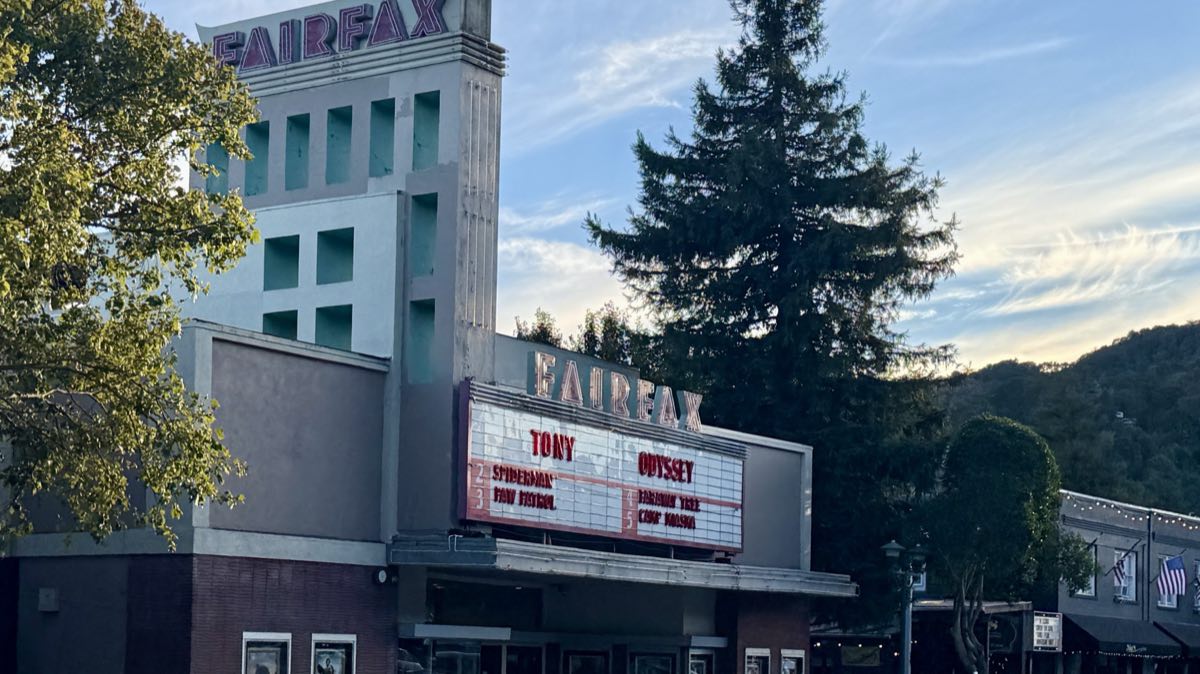
The Fairfax Theatre
Still showing films, still changing the marquee by hand.
We're named after an actual English lord. Charles Snowden Fairfax, 10th Lord Fairfax of Cameron, came west in the gold rush and ended up Speaker of the California Assembly in 1854. He is the only hereditary peer to have held that job.
We hosted the last political duel in California. In 1861 two former assemblymen, Daniel Showalter and Charles Piercy, came to Lord Fairfax's estate to settle an argument. He gave them both lunch and tried to talk them out of it. They went to a field nearby anyway and Showalter killed Piercy.
A man feeding lunch to two people determined to shoot each other, and failing to talk them down, is the most Fairfax story I've ever heard.
Mountain biking was invented here. Not near here. Here. Riders raced modified newsstand bikes down Repack Road, which drops 1,300 feet in under 2.1 miles, so fast that the grease in the coaster brakes boiled off and the hubs had to be repacked between runs. Twenty-two races between 1976 and 1979. The Mountain Bike Hall of Fame moved to downtown Fairfax in 2014, and the Marin Museum of Bicycling opened the year after.
1,300 feet
The drop on Repack Road, in under 2.1 miles, where the mountain bike was worked out between 1976 and 1979
Irving Berlin played a piano in a tree here. At Pastori's Hotel, on the grounds that had been Lord Fairfax's Bird's Nest Glen.
Jefferson Airplane played the Grateful Dead at softball. Central Field, downtown, mid 1960s.
The Marin hot tub started in Fairfax. Al Garvey built a redwood one in July 1966, and a whole county's reputation followed.
Van Morrison lived here in the 1970s, which explains a certain amount.
We've been a town since March 2, 1931. Ninety-five years this year.
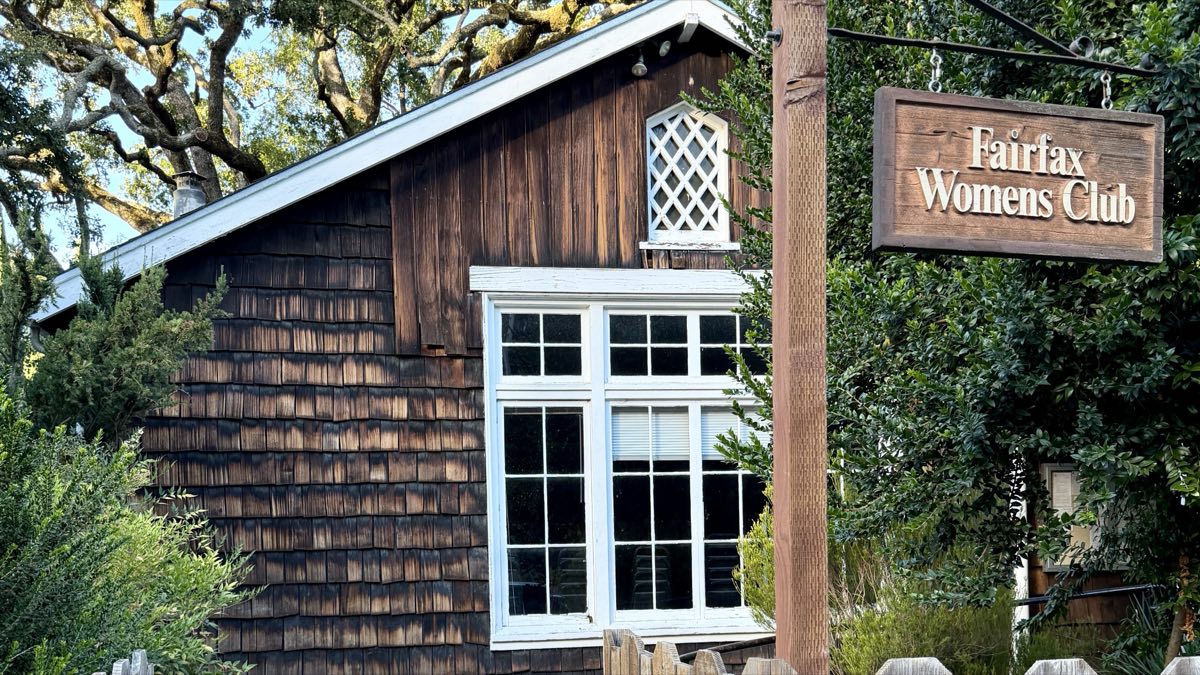
The Fairfax Women's Club
Down the street from the fire station and Peri Park. Town Council meets here, so does the Planning Commission, and a lot of us vote here too.
Last updated . Corrections