Understanding them
Five things people argue about around here, explained plainly. No opinions from me.
I couldn't find this written down anywhere, so I wrote it down.
Why School Street Plaza happened
The most common thing I hear is that particular council members approved 243 units at 95 Broadway. That isn't what happened, and it matters.
The project was reviewed under a ministerial process. Ministerial means staff check the application against the rules already on the books, and if it complies, it gets approved. There's no hearing, no discretion and no vote. The council couldn't have stopped it, and couldn't have made it shorter, or a different color, or set further back.
Two things put it on that track. Fairfax's own Housing Element, the plan the Town adopted, set out a by-right path for housing on sites like this one. And the developer invoked SB 330, the state Housing Crisis Act, which locks in the rules that applied on the day of application and puts the Town on a clock.
The project is 243 homes. 202 at market rate and 41 affordable, which is 25 percent.
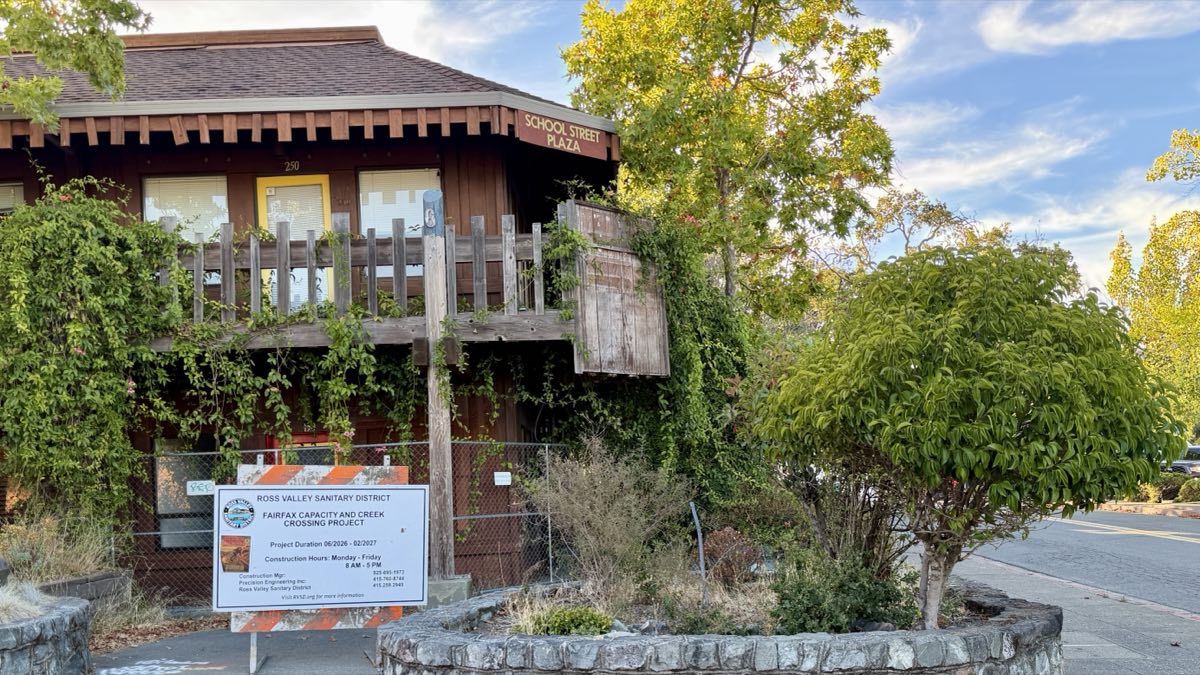
This is what 243 homes replace
The office building behind the fence at 95 Broadway, photographed this month.
You can think that building should be shorter, taller, prettier or somewhere else. Nobody on the council was ever asked.
Where the number 490 came from
Fairfax didn't pick 490 and neither did its council.
Every eight years the state hands each region a housing target, and the region divides it between its cities and towns. That process is called the Regional Housing Needs Allocation, or RHNA, and the number that comes out of it isn't negotiable in any practical sense.
2,298 to 14,405
What Marin County's housing target went up to between the last cycle and this one
Mill Valley went from 129 homes to 865. Fairfax got 490. Towns across Marin appealed, on grounds including fire risk, evacuation capacity, flood zones and a plain lack of buildable land.
Every one of those appeals was denied.
What happens to a town that says no
This is the part almost nobody knows, and it's the reason Fairfax did what it did.
A town whose housing plan isn't certified as compliant loses three things at once.
Money. It becomes ineligible for named state grant programs, including the Permanent Local Housing Allocation, the Local Housing Trust Fund, Infill Infrastructure grants and Caltrans Sustainable Communities money.
Control. It becomes subject to the builder's remedy, under which a housing development can proceed in defiance of local zoning entirely. Not a taller building than you wanted. Any building, more or less anywhere.
Cash. A court can impose fines of $10,000 to $100,000 a month, tripling after three months of continued noncompliance and rising sixfold after six.
$10,000 to $100,000
Monthly court fines a California town can face for an out-of-compliance housing plan, tripling after three months
What the towns that fought found out
There's a version of this where Fairfax refused and took the state on. Some people in town wish it had. It's worth knowing how that has gone for our neighbors.
Sausalito didn't sue the state. Sausalito got sued, by a housing advocacy group, over a housing plan the plaintiffs said didn't comply. Marin's RHNA appeals were all denied. And Sausalito has since voted to rezone for density along Bridgeway anyway.
The towns that fought didn't avoid the housing. They paid legal bills and got the housing.
Worth remembering that Fairfax is projecting $1.67 million in the bank, and that plenty of people here are already unhappy about what we spend on lawyers.
The summer the fleas won
A smaller story, and the clearest illustration of how Fairfax actually operates.
Late July. Parents report children coming home from Peri Park covered in bites. Staff inspect and find a significant flea infestation. The likely source is raccoons, which had been getting under a deck near the playground.
The playground closes. Fairfax bans pesticides, so rather than spray, the Town partners with a university to tarp the playground sand and cook the fleas out with non-toxic heat probes. Reopening expected around August 7.
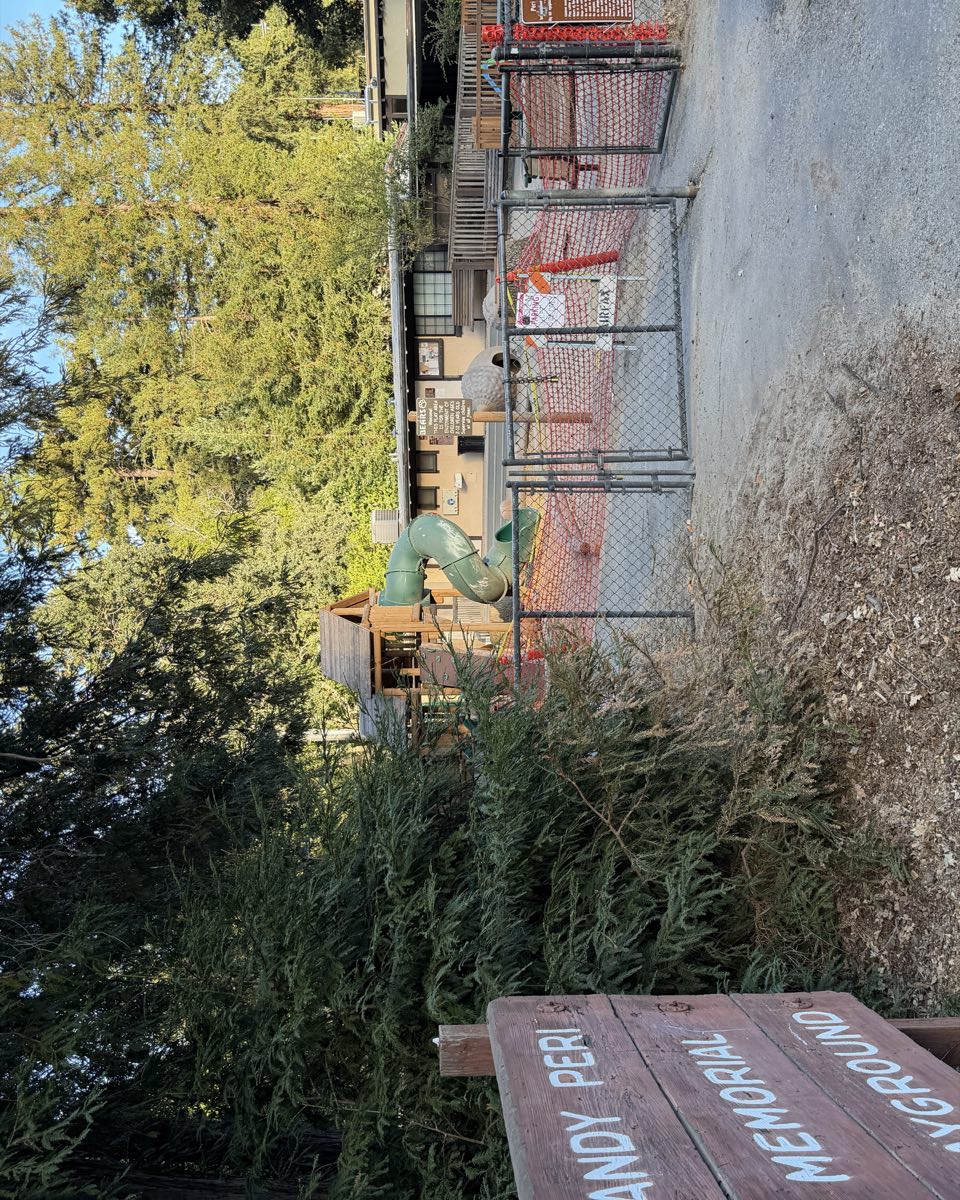
Still fenced on August 25
It was due to reopen around August 7.
Early August. The fleas turn up at the temporary fire station. The council grants an exception to spray underneath the building.
Then they get inside. The crew and engine leave and relocate to Station 20 in Sleepy Hollow. Fairfax has fleas in its firehouse and its firefighters somewhere else.
Station 20
Where Fairfax's crew and engine had to work from, in Sleepy Hollow, while their own building was treated. Cover was maintained throughout
August 20, 3pm. A special council meeting grants a second, wider exception, this time to treat the whole temporary fire station with California-registered flea products applied by a licensed operator.
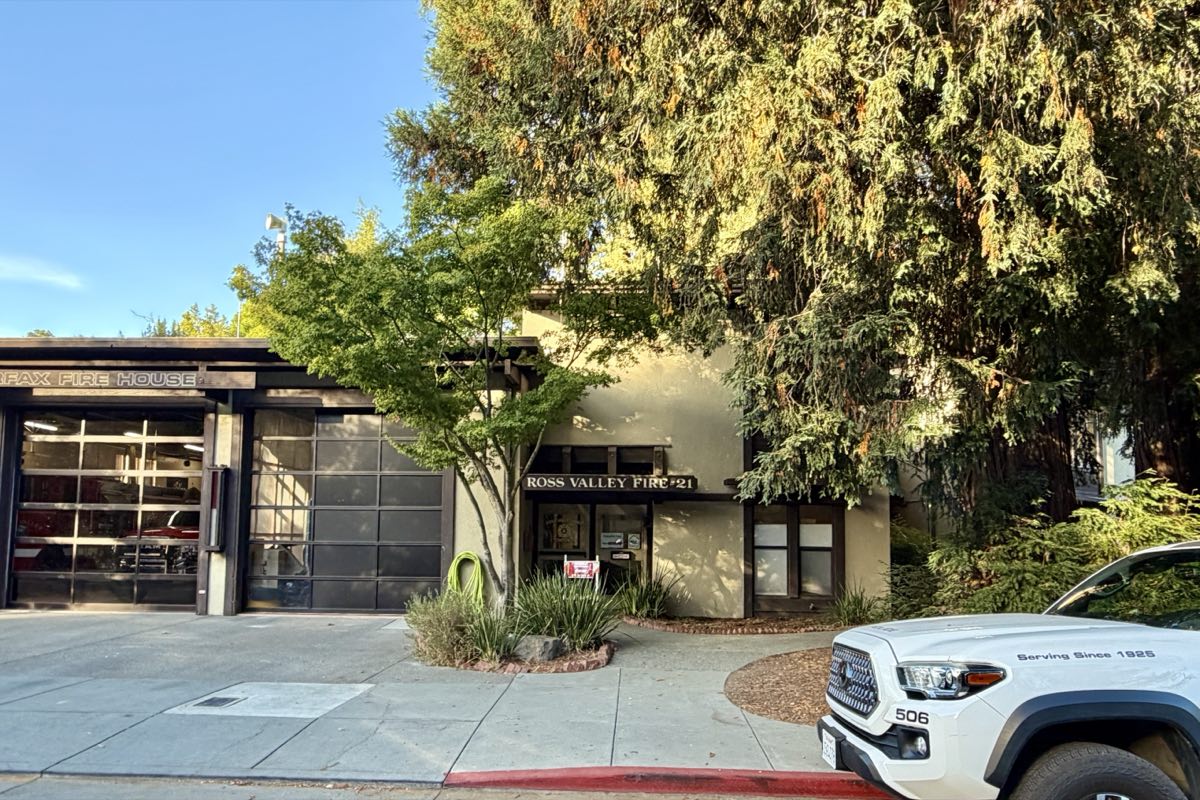
Station 21, Bolinas Road
Crews worked out of Sleepy Hollow while this building was treated.
Since then. The department has reported moving back into the station, and the council has said it intends to revisit the pesticide ordinance. I've heard from people in town that crews still aren't sleeping there.
Why that story matters
Nothing in that sequence was handled badly. The park got the harder, cleaner treatment. The fire station got a narrow exception, then a wider one when the narrow one wasn't enough. Each step was a reasonable answer to the step before it.
The problem is that every step needed its own emergency meeting, because the ordinance has a way to grant an exception and no rule for when.
That isn't a chemicals argument. It's the difference between a town that decides each case from scratch under pressure and a town that wrote down, in advance and in daylight, what a public health exception looks like: licensed applicator, notice to the neighbors, a written report back afterwards.
It's also worth noticing when that meeting was held. Three in the afternoon on a Thursday is when you hold a meeting you can't postpone. It isn't when most people can come.
Your name and neighborhood help if you are happy to give them. Nothing you send will ever be shared without your permission, and I would never sell your information.
Last updated . Corrections